Securing a sustainable competitive advantage is the holy grail for any business aiming for long-term success. This involves understanding market dynamics, leveraging resources effectively, and consistently outperforming competitors. This exploration delves into various strategies, from cost leadership and differentiation to niche market focus and the crucial role of innovation and technology. We’ll examine real-world examples to illustrate how these strategies translate into tangible results, ultimately painting a picture of how businesses can build and maintain their edge in today’s fiercely competitive landscape.
The path to competitive advantage is multifaceted, demanding a thorough understanding of both internal capabilities and external market forces. We will analyze frameworks like Porter’s Five Forces to illuminate the competitive landscape and explore how businesses can build strong brands and utilize technology to solidify their position. By examining diverse strategies and real-world examples, we aim to provide a comprehensive overview of the critical elements required for sustained competitive success.
Defining Competitive Advantage
A competitive advantage is what sets a business apart from its rivals, allowing it to achieve superior performance and profitability. It’s not merely about being better; it’s about creating and sustaining a position that competitors find difficult or impossible to replicate. This advantage can stem from various sources, and its sustainability is crucial for long-term success.A sustainable competitive advantage relies on several core components.
First, it must be valuable, offering something customers want and are willing to pay for. Second, it must be rare, not easily imitated by competitors. Third, it must be inimitable, meaning it’s difficult or costly to copy. Finally, it must be organized, meaning the company has the internal structure and resources to exploit the advantage effectively. Without all four elements, a competitive advantage is likely to be temporary.
Examples of Businesses with Strong Competitive Advantages
Several businesses demonstrate strong, sustainable competitive advantages. Apple, for example, leverages a powerful brand, a seamless ecosystem of products and services, and a strong focus on user experience. This combination creates a loyal customer base that is resistant to switching to competitors. Their design-centric approach and brand loyalty contribute to premium pricing and high profit margins. Similarly, Amazon’s vast logistics network, its customer-centric approach, and its massive data-driven insights allow it to dominate online retail.
The scale of its operations and its efficient fulfillment capabilities make it extremely difficult for competitors to match. Finally, Coca-Cola benefits from a globally recognized brand, extensive distribution networks, and strong brand loyalty built over decades. This powerful brand recognition and wide availability make it a dominant player in the beverage industry.
Comparison of Frameworks for Analyzing Competitive Advantage
Several frameworks help analyze competitive advantage. Porter’s Five Forces model examines industry attractiveness by considering the threat of new entrants, the bargaining power of suppliers and buyers, the threat of substitutes, and the rivalry among existing competitors. This framework helps determine the overall profitability potential of an industry and the opportunities for competitive advantage. In contrast, the VRIO framework (Valuable, Rare, Inimitable, Organized) focuses on the internal resources and capabilities of a firm.
It assesses whether a resource or capability is valuable, rare, difficult to imitate, and whether the firm is organized to exploit it. While Porter’s Five Forces focuses on external factors, VRIO focuses on internal ones, providing a more holistic view when used together.
Hypothetical Business Model with a Clear Competitive Advantage
Consider a hypothetical company, “GreenGrocer,” specializing in hyper-local, sustainable food delivery. Their competitive advantage rests on a vertically integrated model. They partner directly with local farmers, ensuring fresh, high-quality produce. They utilize electric vehicles for delivery, minimizing their carbon footprint and appealing to environmentally conscious consumers. Their strong emphasis on sustainability and traceability creates a unique value proposition, differentiating them from larger, less transparent delivery services.
The combination of direct sourcing, eco-friendly practices, and a strong focus on community engagement makes GreenGrocer’s model difficult for larger competitors to replicate effectively, given the logistical challenges and the commitment required to build similar local partnerships. This creates a sustainable competitive advantage built on both value and rarity.
Cost Leadership
Cost leadership, a fundamental competitive strategy, focuses on achieving the lowest cost of production and distribution within an industry while maintaining acceptable quality. This allows businesses to offer products or services at lower prices than competitors, attracting price-sensitive customers and gaining significant market share. Successfully implementing this strategy requires a deep understanding of cost drivers and a relentless pursuit of efficiency.Cost leadership strategies involve various approaches to minimize expenses across the entire value chain.
Strategies for Achieving Cost Leadership
Businesses employ several strategies to achieve cost leadership. These include optimizing production processes through automation and technological advancements, leveraging economies of scale by increasing production volume, sourcing raw materials and components cost-effectively, and streamlining operations to minimize waste and improve efficiency. Effective cost control measures are also crucial, requiring careful monitoring of expenses and continuous improvement initiatives. Furthermore, strategic partnerships and collaborations can help secure favorable pricing and access to resources.
Industries Dominated by Cost Leadership
Cost leadership is a particularly dominant competitive advantage in industries characterized by standardized products or services and price-sensitive consumers. Examples include the fast-moving consumer goods (FMCG) sector, where companies like Walmart and Aldi thrive on their low-cost structures. Similarly, in the airline industry, budget carriers such as Ryanair and Southwest Airlines have successfully employed cost leadership to gain market share.
The commodity market, including steel and oil production, is another prime example where cost leadership is paramount for profitability.
Comparison of Cost Leadership with Other Competitive Strategies
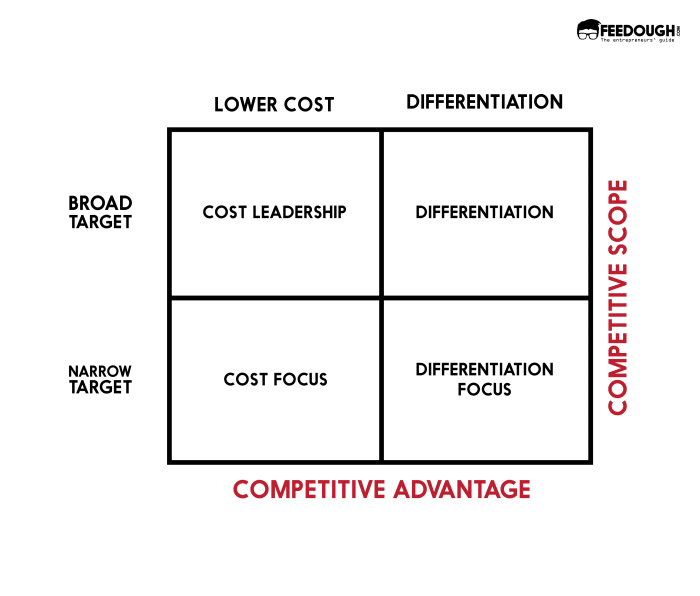
Cost leadership differs significantly from other competitive strategies, such as differentiation and focus. Differentiation focuses on creating unique product features or superior customer service to justify premium pricing, while focus targets a specific niche market segment. Cost leadership, in contrast, prioritizes cost reduction across the board, aiming for a broad market appeal based on low prices. While a company could theoretically combine cost leadership with differentiation (offering a low-cost, high-quality product), this is often challenging to achieve simultaneously.
Focusing solely on cost leadership can lead to a lack of innovation or product differentiation, making the business vulnerable to competitors offering superior features or services.
Implementing a Cost Leadership Strategy
Implementing a successful cost leadership strategy requires a systematic approach. The following table Artikels the key steps, resources needed, and potential challenges involved:
| Step | Action | Resource Needed | Potential Challenges |
|---|---|---|---|
| 1. Cost Analysis | Identify and analyze all cost drivers across the value chain. | Detailed accounting data, process mapping tools, industry benchmarks. | Difficulty in accurately identifying all cost drivers, data inaccuracies. |
| 2. Process Optimization | Streamline operations, improve efficiency, and automate processes where possible. | Technological investments, skilled workforce, process improvement methodologies (e.g., Lean, Six Sigma). | High initial investment costs, resistance to change from employees, integration challenges. |
| 3. Supply Chain Management | Negotiate favorable terms with suppliers, explore alternative sourcing options, and optimize inventory management. | Strong supplier relationships, sophisticated procurement systems, effective logistics networks. | Supplier dependence, supply chain disruptions, geopolitical risks. |
| 4. Cost Control | Implement strict cost control measures, monitor expenses regularly, and eliminate unnecessary costs. | Robust budgeting and financial control systems, effective cost accounting practices. | Maintaining cost control without compromising quality, difficulty in predicting future costs. |
Differentiation
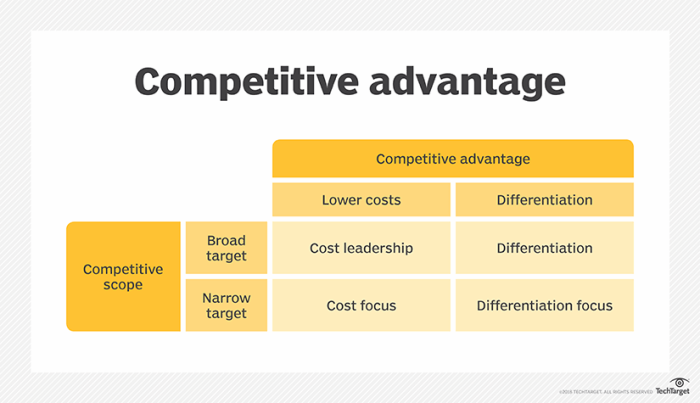
Differentiation, in the context of competitive advantage, involves creating a product or service that is perceived as unique and superior to competitors’ offerings. This uniqueness can stem from various aspects, ranging from product features and design to branding and customer service. A successful differentiation strategy allows a business to command premium prices, build strong brand loyalty, and reduce price competition.Differentiation strategies aim to create a distinct identity in the market, appealing to specific customer needs and preferences that are not adequately addressed by competitors.
This involves a deep understanding of target customer segments and their unmet desires. Effective differentiation goes beyond simply offering a different product; it’s about creating a compelling value proposition that resonates with the chosen customer base.
Methods of Product and Service Differentiation
Businesses can differentiate themselves through a multitude of approaches. Product features and functionality are often a primary differentiator, with companies investing heavily in research and development to create innovative and technologically advanced offerings. Design and aesthetics play a crucial role, particularly in industries like fashion, consumer electronics, and automobiles. Branding and marketing efforts cultivate a strong brand image and emotional connection with consumers.
Superior customer service, including personalized experiences and responsive support, can also be a significant differentiator. Finally, distribution channels and access can create a competitive edge, particularly in markets with limited access to certain products or services. For instance, a company offering exclusive access through a subscription model or a specialized retail network can effectively differentiate itself.
Examples of Successful Differentiation
Apple’s consistent focus on design, user experience, and a carefully curated ecosystem exemplifies successful differentiation. Their products are often perceived as premium, commanding higher prices than competitors due to their perceived superior quality and brand prestige. Similarly, Tesla differentiated itself in the automotive industry by focusing on electric vehicles and advanced technology, appealing to environmentally conscious consumers and technology enthusiasts.
In the fast-food industry, Chipotle Mexican Grill successfully differentiated itself by emphasizing fresh, high-quality ingredients and customizable meals, attracting health-conscious customers. These examples highlight how focusing on a specific aspect of the customer experience or product attributes can lead to a sustainable competitive advantage.
Challenges in Maintaining Differentiation
Maintaining a differentiated position in a dynamic market presents significant challenges. Competitors constantly strive to imitate successful strategies, leading to a decrease in the perceived uniqueness of a product or service. Rapid technological advancements can quickly render existing differentiators obsolete, requiring continuous innovation and adaptation. Changing consumer preferences and emerging trends also necessitate a flexible approach to differentiation, ensuring that the value proposition remains relevant and appealing.
Furthermore, managing the costs associated with maintaining differentiation can be substantial, particularly in areas such as research and development, marketing, and premium customer service. The challenge lies in striking a balance between innovation and profitability.
Unique Differentiation Strategies
The following list Artikels five distinct differentiation strategies:
- Value-Based Differentiation: Focusing on offering superior value for the price, often by combining high quality with competitive pricing. This strategy requires efficient operations and cost management to maintain profitability while delivering exceptional value to the customer.
- Niche Differentiation: Targeting a specific, underserved segment of the market with a specialized product or service. This approach minimizes direct competition and allows for a deep understanding of customer needs within the niche.
- Technology-Based Differentiation: Leveraging cutting-edge technology to create innovative products or services with superior functionality and performance. This strategy requires significant investment in research and development but can result in a significant competitive advantage.
- Brand Differentiation: Building a strong brand identity and reputation that resonates with consumers on an emotional level. This involves consistent branding, marketing, and customer experience management to cultivate brand loyalty and premium pricing.
- Service Differentiation: Providing exceptional customer service that exceeds customer expectations. This might include personalized support, rapid response times, convenient access, and proactive problem-solving. A superior service experience can create a strong competitive edge and foster customer loyalty.
Innovation
Innovation is the lifeblood of sustained competitive advantage. It’s the engine that drives growth, allows businesses to adapt to changing market conditions, and ultimately, outpace rivals. Without a consistent commitment to innovation, even the strongest companies risk becoming obsolete. This section explores the multifaceted role of innovation in achieving and maintaining a competitive edge.Innovation encompasses the creation and implementation of novel ideas, processes, and products.
It’s not merely about inventing something new; it’s about successfully bringing that invention to market and integrating it into a company’s overall strategy. This process can significantly impact a company’s market share, profitability, and long-term viability. A strong innovation strategy allows businesses to not only meet but anticipate customer needs, creating new markets and shaping consumer preferences.
Types of Innovation and Their Impact
Businesses can pursue various types of innovation to gain a competitive advantage. Understanding these different approaches is crucial for developing a comprehensive strategy.
- Product Innovation: This involves creating entirely new products or significantly improving existing ones. For example, Apple’s continuous innovation in smartphones, with each new iPhone iteration featuring advancements in technology and design, exemplifies product innovation’s power. This consistent release of improved products maintains customer loyalty and generates significant revenue.
- Process Innovation: This focuses on improving the efficiency and effectiveness of a company’s internal operations. Toyota’s pioneering of the lean manufacturing system, which minimized waste and maximized efficiency, is a prime example. This process innovation significantly reduced production costs and improved quality, giving Toyota a substantial competitive edge.
- Business Model Innovation: This involves fundamentally changing how a company creates, delivers, and captures value. Netflix’s shift from DVD rentals to streaming, disrupting the traditional movie rental industry, showcases the transformative potential of business model innovation. This move broadened their customer base and redefined how people consume entertainment.
Protecting Innovative Ideas Through Intellectual Property
Protecting innovative ideas is critical for sustaining a competitive advantage. Intellectual property (IP) rights, such as patents, trademarks, and copyrights, provide legal protection for inventions, brands, and creative works.Securing patents for novel inventions prevents competitors from copying the technology, providing a period of exclusivity to reap the benefits of innovation. Trademarks protect brand identities, safeguarding brand recognition and customer loyalty.
Copyrights protect original creative works, preventing unauthorized reproduction and distribution. A robust IP strategy is essential for companies to fully leverage the returns from their investments in research and development. For example, pharmaceutical companies heavily rely on patent protection to maintain market exclusivity for their new drugs, recouping their substantial R&D investment.
Examples of Businesses Leveraging Innovation
Numerous businesses have successfully leveraged innovation to gain a competitive edge. Consider the following:
- Tesla: Tesla revolutionized the automotive industry through its innovative electric vehicles and battery technology. This combination of product and process innovation has created a highly desirable brand and disrupted the traditional automotive market.
- Amazon: Amazon’s innovative business model, including its e-commerce platform, cloud computing services (AWS), and personalized recommendations, has transformed retail and technology. This approach showcases the power of business model innovation in creating a dominant market position.
- Spotify: Spotify’s innovative music streaming service disrupted the music industry by providing a convenient and affordable way to access millions of songs. This product and business model innovation established a new standard for music consumption.
Competitive Advantage and Technology
Technology has fundamentally reshaped the competitive landscape across all industries. Its strategic deployment is no longer a luxury but a necessity for businesses aiming to thrive, let alone survive. Companies leveraging technology effectively can gain significant advantages over competitors, impacting everything from operational efficiency to customer loyalty and the creation of entirely new markets.Technology’s Role in Creating Competitive AdvantageTechnology offers a multitude of pathways to establishing a competitive edge.
It enables businesses to streamline operations, reducing costs and increasing productivity. Simultaneously, it provides avenues for enhancing the customer experience, fostering stronger relationships and brand loyalty. Perhaps most importantly, technology facilitates innovation, allowing businesses to develop entirely new products, services, and business models that disrupt existing markets. This multifaceted impact makes technological proficiency a cornerstone of modern competitive strategy.
Examples of Technology’s Impact on Business
Numerous businesses exemplify the power of technology to drive competitive advantage. Amazon, for instance, utilizes advanced algorithms and data analytics to personalize customer recommendations, optimize its supply chain, and offer unparalleled convenience. This has solidified its position as a dominant player in e-commerce. Netflix leverages sophisticated data analysis to predict viewing preferences, enabling it to curate content and personalize recommendations, thereby enhancing user engagement and retention.
Tesla’s success stems partly from its integration of technology into its vehicle design, manufacturing, and sales processes, creating an innovative and highly desirable product. These examples highlight the diverse ways technology can be used to gain a competitive edge.
Challenges in Maintaining Technological Advantage
The rapid pace of technological advancement presents significant challenges for businesses seeking to maintain a competitive edge. Staying ahead of the curve requires continuous investment in research and development, employee training, and the adoption of new technologies. Moreover, companies must be adept at adapting to changing technological landscapes, recognizing that even the most innovative solutions can quickly become obsolete.
Failure to keep pace can lead to a loss of market share and competitive relevance. For example, companies that failed to adapt to the rise of mobile technology or the shift towards cloud computing often faced significant setbacks. Therefore, a proactive and adaptable approach to technology management is crucial.
Technology and Competitive Strategies: Cost Leadership vs. Differentiation
The following table compares the use of technology to achieve cost leadership versus differentiation:
| Technology Application | Cost Leadership | Differentiation | Examples |
|---|---|---|---|
| Automation | Reduces labor costs, increases efficiency | Enables customization and personalization at scale | Robotics in manufacturing (Cost), AI-powered personalized recommendations (Differentiation) |
| Data Analytics | Optimizes resource allocation, identifies cost savings | Provides insights into customer preferences, enabling targeted marketing | Supply chain optimization (Cost), Customer segmentation for tailored products (Differentiation) |
| Cloud Computing | Reduces infrastructure costs, improves scalability | Enables rapid deployment of new features and services | Migrating servers to cloud providers (Cost), Agile software development (Differentiation) |
| AI & Machine Learning | Automates repetitive tasks, improves predictive maintenance | Creates innovative products and services, enhances customer experience | Fraud detection (Cost), Chatbots for customer service (Differentiation) |
Building a Strong Brand
A strong brand is more than just a logo; it’s the foundation of a sustainable competitive advantage. It represents the sum of consumer perceptions, experiences, and beliefs about a company and its products or services. Building a powerful brand fosters customer loyalty, allows for premium pricing, and creates a significant barrier to entry for competitors. Ultimately, a strong brand translates directly into increased profitability and market share.A well-built brand acts as a powerful differentiator, even in highly competitive markets.
It allows companies to command higher prices, attract and retain top talent, and weather economic downturns more effectively than their less-branded counterparts. This is because consumers are willing to pay a premium for products and services associated with a brand they trust and value.
Examples of Companies with Strong Brands
Apple’s success is intrinsically linked to its brand. Its sleek designs, user-friendly interfaces, and carefully cultivated image of innovation command premium prices and inspire fierce loyalty among consumers. Similarly, Coca-Cola’s brand recognition is virtually unmatched globally. Its consistent messaging, iconic imagery, and decades-long investment in brand building have cemented its position as a dominant player in the beverage industry.
These companies leverage their brand equity to launch new products and expand into new markets with relative ease, a feat difficult for companies lacking similar brand recognition.
Methods Used to Build a Strong Brand
Building a strong brand requires a multifaceted approach. Marketing plays a crucial role in shaping brand perception through targeted advertising campaigns, consistent messaging, and strategic partnerships. Exceptional customer service fosters positive brand experiences, leading to increased customer loyalty and positive word-of-mouth referrals. Public relations helps manage the company’s image and reputation, mitigating potential crises and capitalizing on opportunities to enhance its standing in the public eye.
Beyond these core elements, consistent quality of products and services is paramount. A brand promise must be reliably delivered.
Elements of a Successful Branding Strategy
A successful branding strategy requires careful planning and execution. Key elements include:
- Clear Brand Identity: Defining a unique brand personality, values, and mission statement that resonate with the target audience.
- Consistent Messaging: Maintaining a consistent brand voice and visual identity across all communication channels.
- Targeted Marketing: Reaching the right audience with the right message through effective advertising and promotional activities.
- Exceptional Customer Service: Providing outstanding customer experiences that foster loyalty and positive word-of-mouth referrals.
- Strong Brand Storytelling: Communicating the brand’s history, values, and mission in a compelling and engaging way.
- Effective Public Relations: Managing the brand’s reputation and proactively addressing any negative publicity.
- Monitoring and Adaptation: Continuously monitoring brand perception and adapting the strategy as needed to stay relevant and competitive.
Analyzing the Competitive Landscape
Understanding the competitive landscape is crucial for businesses aiming for sustainable success. A thorough analysis allows companies to identify opportunities, mitigate threats, and ultimately, develop effective strategies to achieve a competitive advantage. This involves a systematic examination of the market, its key players, and the dynamics at play.Analyzing the competitive landscape requires considering several key factors. A comprehensive assessment goes beyond simply identifying competitors; it delves into their strengths, weaknesses, strategies, and potential future actions.
Key Factors in Competitive Landscape Analysis
Understanding the competitive landscape necessitates examining several crucial aspects. These factors collectively paint a picture of the market’s dynamics and inform strategic decision-making. Ignoring any of these elements can lead to inaccurate assessments and ineffective strategies.
- Market Size and Growth: Assessing the overall size of the market and its projected growth rate provides a foundation for understanding the potential for expansion and profitability.
- Industry Structure: Analyzing the industry structure—whether it’s monopolistic, oligopolistic, or perfectly competitive—reveals the level of competition and the potential for price wars or collaborative efforts.
- Competitor Analysis: This involves a deep dive into each key competitor, examining their market share, strategies, strengths, weaknesses, and potential future moves. This is often done using methods such as SWOT analysis or competitor profiling.
- Customer Analysis: Understanding customer needs, preferences, and buying behavior is vital for developing effective products and marketing strategies. This includes segmenting the market and identifying target customer groups.
- Technological Factors: Technological advancements can disrupt industries and create new opportunities. Monitoring technological trends is essential for identifying potential threats and opportunities.
- Regulatory Environment: Government regulations and policies can significantly impact the industry. Understanding the regulatory landscape is critical for compliance and strategic planning.
Examples of Competitive Analysis in Action
Several companies effectively utilize competitive analysis to shape their strategies. For example, consider how Netflix leveraged its understanding of Blockbuster’s weaknesses (reliance on physical stores, late fees) to build its streaming platform, ultimately disrupting the video rental market. Similarly, Apple’s consistent focus on user experience and design, in contrast to competitors focusing solely on specifications, has cemented its position in the tech industry.
These examples highlight the importance of not just identifying competitors but understanding their vulnerabilities and leveraging them to create a distinct competitive advantage.
Methods for Analyzing Competitors
Several methods exist for conducting a thorough competitor analysis. Each approach offers a unique perspective, and combining them often yields the most comprehensive understanding.
- SWOT Analysis: This classic framework analyzes a competitor’s Strengths, Weaknesses, Opportunities, and Threats. It helps identify areas where a competitor excels and where it is vulnerable.
- Competitor Profiling: This involves creating detailed profiles of key competitors, including their business models, target markets, strategies, and resources. This provides a comprehensive overview of each competitor’s capabilities and potential.
- Porter’s Five Forces: This model examines the competitive intensity of an industry by analyzing the threat of new entrants, the bargaining power of suppliers and buyers, the threat of substitute products, and the rivalry among existing competitors.
Hypothetical Competitive Landscape Analysis: The Coffee Shop Industry
Let’s consider a hypothetical analysis of the coffee shop industry in a mid-sized city.
| Company | Competitive Advantage | Strengths | Weaknesses |
|---|---|---|---|
| Starbucks | Brand recognition, wide reach, loyalty program | Strong brand, established supply chain, global presence | High prices, potential for brand saturation |
| Local Independent Coffee Shop (e.g., “The Daily Grind”) | Community focus, unique atmosphere, personalized service | Strong local following, potential for higher profit margins | Limited marketing reach, susceptibility to economic downturns |
| Dunkin’ | Value pricing, convenient locations, fast service | Extensive locations, efficient operations, low prices | Limited customization options, less premium feel |
This simplified analysis shows the diverse competitive advantages within the coffee shop industry. Starbucks leverages its brand recognition and global reach, while local shops thrive on community engagement and personalized service. Dunkin’ focuses on value and convenience. Understanding these differences is crucial for any new entrant hoping to establish itself in this competitive market.
Ultimately, achieving a sustainable competitive advantage requires a holistic approach, integrating various strategies tailored to the specific business and its market. Whether focusing on cost leadership, differentiation, niche market dominance, or leveraging technological innovation, consistent adaptation and a deep understanding of the competitive landscape are paramount. By strategically aligning internal capabilities with external opportunities, businesses can build a resilient and enduring competitive advantage, ensuring long-term prosperity and market leadership.
Common Queries
What is the difference between a competitive advantage and a sustainable competitive advantage?
A competitive advantage simply means a business outperforms its rivals. A
-sustainable* competitive advantage implies this outperformance is durable and difficult for competitors to replicate, often due to unique resources or capabilities.
Can a small business develop a competitive advantage?
Absolutely. Small businesses often leverage agility, niche specialization, and personalized customer service to create a competitive advantage against larger corporations.
How important is intellectual property in achieving a competitive advantage?
Intellectual property (patents, trademarks, copyrights) can be crucial for protecting innovative products, processes, or brands, creating a significant barrier to entry for competitors and securing a sustainable competitive edge.
What role does marketing play in establishing a competitive advantage?
Effective marketing is essential for communicating a company’s unique value proposition, building brand awareness, and ultimately driving demand, contributing significantly to a competitive advantage.