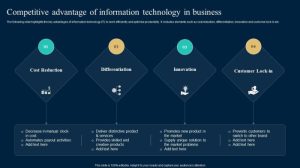
Understanding competitive advantage is crucial for business success. It’s not merely about outperforming rivals; it’s about creating a sustainable edge that allows a company to consistently deliver superior value to customers and outperform the competition. This involves a deep understanding of various strategies, from cost leadership to innovation, and recognizing how these strategies interact to shape a company’s market position.
This exploration will delve into the diverse approaches businesses employ to establish and maintain a competitive advantage, examining their strengths, weaknesses, and the factors that determine their long-term viability.
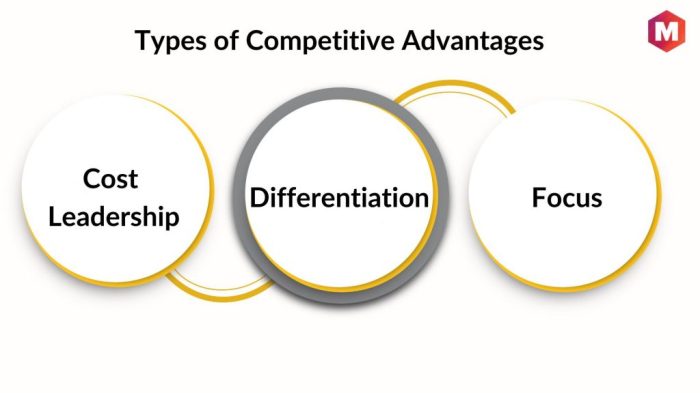
We’ll examine several key types of competitive advantages, including cost leadership, differentiation, niche market specialization, innovation, resource-based advantages, first-mover advantages, and network effects. Each of these strategies offers unique pathways to success, but they also present distinct challenges and require careful consideration of market dynamics and the company’s specific resources and capabilities. We’ll analyze real-world examples to illustrate the effectiveness—and potential pitfalls—of each approach.
Defining Competitive Advantage
A competitive advantage represents a firm’s ability to outperform its rivals, offering greater value to customers or achieving lower costs than competitors. This superiority translates into higher profits, increased market share, and sustained success in a dynamic marketplace. Understanding and leveraging competitive advantages are crucial for long-term business viability.A competitive advantage differs fundamentally from a competitive strategy. A competitive advantage is the
- what* – the specific attribute or capability that sets a company apart. A competitive strategy is the
- how* – the plan of action employed to exploit that advantage and achieve business objectives. The strategy Artikels the specific tactics and approaches used to capitalize on the underlying advantage. For example, a superior product quality (competitive advantage) might be supported by a strategy focused on premium pricing and targeted marketing.
Competitive Advantage Examples
Several companies demonstrate robust competitive advantages. Apple, for instance, has cultivated a strong brand reputation for design and user experience, fostering fierce customer loyalty and justifying premium pricing. This brand loyalty, coupled with a tightly integrated ecosystem of hardware and software, forms a powerful competitive advantage. Conversely, Walmart’s competitive advantage rests on its efficient supply chain and vast distribution network, allowing it to offer lower prices than most competitors.
This cost leadership strategy enables them to maintain significant market share. Finally, consider Google, whose competitive advantage stems from its dominant position in search and its vast data holdings. This provides them with unparalleled insights into consumer behavior, enabling highly targeted advertising and the development of innovative services. These examples illustrate how different competitive advantages can lead to sustained success in diverse industries.
Cost Leadership

Cost leadership, a fundamental competitive strategy, focuses on achieving the lowest cost of production and distribution within an industry while maintaining acceptable quality. This allows a company to offer its products or services at a lower price than competitors, attracting price-sensitive customers and gaining a significant market share. Successfully implementing a cost leadership strategy requires a deep understanding of the entire value chain and a relentless pursuit of efficiency.Cost leadership characteristics include consistently low production costs, efficient operations, economies of scale, and a streamlined supply chain.
Companies employing this strategy often target a broad market segment, emphasizing volume sales to offset lower profit margins per unit. While price is a key differentiator, maintaining a level of quality that meets customer expectations is crucial to avoid compromising brand reputation.
Characteristics of Cost Leadership
A cost leadership strategy hinges on several key characteristics. These include efficient resource utilization, technological advancements that improve productivity, and effective cost control across all aspects of the business. Negotiating favorable terms with suppliers and optimizing logistics are also essential. Furthermore, a commitment to continuous improvement and process optimization is vital for sustaining a cost leadership position in a dynamic market environment.
A strong focus on automation and lean manufacturing principles can significantly reduce operational costs.
Comparison of Cost Leadership with Other Competitive Advantages
| Advantage Type | Description | Strengths | Weaknesses |
|---|---|---|---|
| Cost Leadership | Offering the lowest price in the market while maintaining acceptable quality. | High market share, strong profitability (despite lower margins per unit), resilience to price wars. | Vulnerability to changes in input costs, potential for sacrificing quality, difficulty in innovating beyond cost reduction. |
| Differentiation | Offering unique products or services that are perceived as superior by customers. | Premium pricing, strong brand loyalty, less susceptibility to price competition. | Higher production costs, potential for niche markets, vulnerability to imitation. |
| Focus (Niche) | Concentrating on a specific market segment with specialized needs. | Strong customer relationships, higher margins, less competition within the niche. | Limited market reach, vulnerability to changes in the target segment, higher dependence on a single market. |
| Innovation | Continuously developing and introducing new products or services. | First-mover advantage, high profit potential, strong competitive edge. | High risk of failure, significant R&D investment, rapid obsolescence. |
Methods for Achieving Cost Leadership
Companies utilize various methods to achieve cost leadership. These include leveraging economies of scale through mass production, investing in advanced technology to automate processes and improve efficiency, and optimizing the supply chain to reduce procurement and logistics costs. Effective inventory management, minimizing waste, and negotiating favorable contracts with suppliers are also crucial. Furthermore, a focus on lean manufacturing principles, which aim to eliminate waste and maximize efficiency, is vital for sustaining a cost leadership advantage.
For example, Walmart’s efficient supply chain and logistics network allows them to offer lower prices than many competitors. Similarly, McDonald’s standardized processes and economies of scale contribute to its cost leadership position.
Differentiation
Differentiation, a core competitive strategy, focuses on creating a product or service perceived as unique and superior by customers, justifying a premium price. This contrasts with cost leadership, which aims for the lowest price. Successful differentiation hinges on understanding and fulfilling unmet customer needs or desires, often leading to strong brand loyalty and higher profit margins.Differentiation Strategy Key ElementsDifferentiation requires a strategic approach that goes beyond simple product features.
It involves understanding the target market’s values and preferences, identifying areas where competitors are lacking, and creating a compelling value proposition that resonates with customers. Key elements include superior product quality, innovative design, strong branding, exceptional customer service, and a unique distribution network. A well-executed differentiation strategy builds a strong brand identity, fostering customer loyalty and creating a significant barrier to entry for competitors.
Examples of Successful Differentiation Strategies
Several companies across diverse industries have successfully employed differentiation strategies. The following examples illustrate the breadth and depth of this approach.
- Apple (Technology): Apple differentiates itself through a seamless ecosystem of hardware, software, and services, emphasizing user-friendly design and premium branding. This fosters a strong brand loyalty, allowing them to command premium prices for their products.
- Starbucks (Food and Beverage): Starbucks differentiated itself through its “third place” concept, creating a welcoming atmosphere and offering high-quality coffee in a comfortable setting. This experience-based differentiation set it apart from competitors.
- Rolls-Royce (Automotive): Rolls-Royce’s differentiation strategy centers on luxury, exclusivity, and bespoke craftsmanship. Their vehicles are handcrafted to meet individual customer specifications, justifying their exceptionally high prices.
- Nike (Apparel and Footwear): Nike successfully differentiates through innovative product design, endorsements by top athletes, and powerful marketing campaigns that cultivate a strong brand image associated with performance and aspiration.
- Disney (Entertainment): Disney differentiates through its unique brand of family-friendly entertainment, encompassing theme parks, movies, and merchandise, all built around consistent storytelling and character development. This creates a powerful emotional connection with its customers.
Challenges of Maintaining Differentiation Advantage
Maintaining a differentiation advantage in a competitive market presents several challenges. Competitors constantly strive to replicate or surpass unique features, necessitating continuous innovation and adaptation. Protecting intellectual property, managing costs effectively while maintaining quality, and adapting to changing consumer preferences are crucial. Furthermore, the effectiveness of a differentiation strategy can be undermined by the emergence of disruptive technologies or shifts in consumer tastes.
Companies must invest heavily in research and development, marketing, and brand building to maintain their edge. Failure to do so can lead to a loss of market share and a decline in profitability.
Niche Market Specialization
Focusing on a niche market allows businesses to concentrate their resources and expertise on a specific segment of the market, leading to a powerful competitive advantage. By catering to a smaller, more defined group of customers, companies can develop specialized products or services that meet their unique needs and desires more effectively than larger, more generalized competitors. This focused approach can translate into higher profit margins, increased customer loyalty, and a stronger brand identity.By specializing in a niche, businesses can build a reputation for expertise and excellence within that specific area.
This reputation attracts customers who value specialized knowledge and tailored solutions. Furthermore, focusing on a niche can reduce competition, as larger companies may overlook or underestimate the potential of these smaller, specialized markets. This reduced competition allows niche players to command premium prices and build sustainable businesses.
Examples of Successful Niche Market Specialization
Several companies have successfully leveraged niche market specialization to achieve significant growth and profitability. For example, Bombas, a sock company, focused on comfort and ethical production, targeting a segment of consumers who value both quality and social responsibility. Their innovative designs and commitment to donating socks to those in need have cultivated a loyal customer base and solidified their position within the niche market.
Another example is Warby Parker, an eyewear company that disrupted the traditional optical industry by offering stylish, affordable glasses directly to consumers online. Their focus on a specific consumer demographic and efficient online sales model allowed them to carve out a significant market share. Finally, Blue Apron, initially a meal-kit delivery service, targeted busy professionals and families who desired convenient and healthy meal options, avoiding the complexities of grocery shopping and meal preparation.
Although facing challenges in recent years, their initial success highlights the potential of niche market specialization.
Strategies for Identifying and Penetrating a Profitable Niche Market
Identifying a profitable niche requires careful market research and analysis. This involves understanding consumer needs, preferences, and buying behaviors within specific market segments. Analyzing market trends, competitive landscapes, and potential profit margins is crucial. Thorough market research may involve surveys, focus groups, and analysis of existing market data to identify underserved or overlooked segments.Once a promising niche has been identified, developing a targeted marketing strategy is essential.
This involves crafting a compelling brand message that resonates with the specific needs and desires of the target audience. Effective marketing channels for niche markets might include social media marketing, targeted advertising, content marketing, and influencer outreach. Building strong relationships with key influencers and community leaders within the niche can significantly boost brand awareness and credibility. Finally, providing exceptional customer service is crucial for building loyalty and driving repeat business within a niche market.
A personalized approach, responsive communication, and a commitment to exceeding customer expectations are vital for long-term success.
Innovation as a Competitive Advantage
Innovation is the lifeblood of sustained competitive advantage in today’s dynamic marketplace. Companies that consistently develop and implement new ideas, products, and processes are better positioned to outperform their rivals, capture market share, and enhance profitability. This stems from their ability to offer superior value to customers, create barriers to entry for competitors, and adapt quickly to changing market conditions.
Innovation isn’t simply about inventing something new; it’s about effectively translating creative ideas into tangible business benefits.Innovation drives competitive advantage by creating a significant gap between a company and its competitors. This gap can manifest in several ways, such as offering a superior product, reducing production costs, accessing new markets, or improving operational efficiency. A company with a strong innovation pipeline can consistently disrupt the status quo, forcing competitors to react and potentially fall behind.
This proactive approach, rather than a reactive one, is crucial for long-term success.
Types of Innovation and Their Impact on Competitive Advantage
The impact of innovation on competitive advantage is multifaceted and depends heavily on the type of innovation pursued. Different approaches lead to different outcomes, each with its own strengths and weaknesses. Understanding these nuances is critical for strategic decision-making.
- Product Innovation: This involves creating entirely new products or significantly improving existing ones. For example, Apple’s introduction of the iPhone revolutionized the mobile phone market, creating a new category of devices and establishing a dominant market position. This type of innovation directly impacts customer value and can lead to significant market share gains.
- Process Innovation: This focuses on improving the efficiency and effectiveness of production processes. Toyota’s pioneering of the lean manufacturing system is a prime example. By streamlining operations and reducing waste, they achieved significant cost advantages and improved quality, enhancing their competitive edge.
- Business Model Innovation: This involves creating new ways of doing business, often disrupting existing industry structures. Netflix’s shift from DVD rentals to streaming transformed the entertainment industry, demonstrating the power of innovative business models to create entirely new markets and competitive landscapes.
- Marketing Innovation: This involves creating new and effective marketing strategies to reach and engage customers. The use of social media marketing and targeted advertising are examples of marketing innovations that have significantly altered how companies interact with their customer base, allowing for more personalized experiences and improved conversion rates.
- Organizational Innovation: This focuses on improving internal processes, structures, and cultures to enhance efficiency and effectiveness. Companies that embrace agile methodologies, for instance, are often better able to adapt to changing market demands and respond quickly to new opportunities. This fosters a culture of continuous improvement and adaptability.
Risks and Rewards of Investing in Innovation
Investing in innovation is inherently risky, but the potential rewards can be substantial. Companies need to carefully weigh the potential benefits against the inherent uncertainties.
Rewards: Increased market share, higher profit margins, enhanced brand reputation, improved customer loyalty, new revenue streams, first-mover advantage, and the ability to set industry standards are all potential rewards. The success of companies like Google, Amazon, and Tesla stand as testament to the transformative power of successful innovation.
Risks: High development costs, uncertain market demand, technological obsolescence, competitive imitation, failure to achieve expected returns, and the potential for significant financial losses are all significant risks. The failure rate for new products and services is notoriously high, highlighting the importance of thorough market research and a well-defined innovation strategy. For instance, many companies have invested heavily in virtual reality technology only to find limited market adoption.
Competitive Advantage through Superior Resources and Capabilities
Sustained competitive advantage isn’t solely about offering a cheaper product or a unique feature; it often hinges on possessing superior resources and capabilities that competitors struggle to replicate. This approach, grounded in the Resource-Based View (RBV), emphasizes the internal strengths of a firm as the primary driver of competitive success. By effectively utilizing these resources and capabilities, companies can establish a defensible position in the market, leading to above-average profitability and long-term growth.The Resource-Based View (RBV) of competitive advantage posits that a firm’s unique resources and capabilities are the key drivers of its competitive advantage.
It argues that these resources, when valuable, rare, inimitable, and non-substitutable (VRIN), create a sustainable competitive advantage. This framework shifts the focus from external market analysis to an internal assessment of the firm’s unique assets and competencies. The ability to effectively deploy and manage these resources is critical for translating them into a competitive edge.
Tangible and Intangible Resources: A Comparison
Tangible resources are the physical assets a company possesses, such as its plant and equipment, financial resources, raw materials, and geographic location. Intangible resources, on the other hand, are non-physical assets, including brand reputation, intellectual property (patents, copyrights, trademarks), organizational culture, and knowledge. While tangible resources can contribute to competitive advantage, intangible resources often prove more valuable and harder for competitors to imitate.
For example, a strong brand reputation built over decades can command premium prices and create significant customer loyalty, while a competitor would struggle to replicate this overnight. Similarly, proprietary technology protected by patents creates a significant barrier to entry for rivals.
Examples of Companies Leveraging Resources and Capabilities
Apple’s sustained competitive advantage is a prime example of leveraging both tangible and intangible resources. Their tangible resources include advanced manufacturing facilities and a global distribution network. However, their intangible resources, such as their strong brand reputation, innovative design capabilities, and loyal customer base, are arguably even more critical to their success. Apple’s ecosystem of products and services, along with its user-friendly interface, creates a powerful network effect, making it difficult for competitors to attract customers.Another compelling example is Coca-Cola.
While their tangible resources such as bottling plants and distribution channels are important, their unparalleled brand recognition and global distribution network are key intangible assets that have driven their long-term success. The iconic Coca-Cola brand, built over decades of marketing and brand building, is a powerful competitive weapon, creating strong customer loyalty and allowing them to command premium prices.
This brand recognition is extremely difficult for competitors to replicate. Furthermore, their extensive global distribution network ensures product availability across diverse markets, another significant advantage.
First-Mover Advantage
Securing a first-mover advantage can be a powerful strategy for achieving long-term market dominance. This involves being the first company to introduce a product or service to a market, thereby establishing a significant head start over potential competitors. However, it’s crucial to understand that this approach is not without its inherent risks.First-mover advantage offers several potential benefits, including the opportunity to capture a significant portion of early adopters, establish brand recognition and loyalty, and shape industry standards.
This early market penetration can create significant barriers to entry for later entrants, giving the first-mover considerable time to build market share and economies of scale. However, the risks are equally substantial, encompassing high development costs, the potential for unforeseen technological shifts, and the possibility of misjudging market demand.
Benefits and Risks of First-Mover Advantage
The benefits of being a first-mover are considerable but must be weighed against the substantial risks involved. A successful first-mover can reap significant rewards, while a failure can result in substantial losses and missed opportunities. The potential for high returns often attracts many companies, but the high risk of failure must be acknowledged and mitigated as much as possible through careful market research and strategic planning.
Examples of Successful and Unsuccessful First-Movers
Several companies have successfully leveraged first-mover advantage. For example, Apple’s introduction of the iPhone revolutionized the mobile phone industry, establishing a dominant market position that continues to this day. Similarly, Amazon’s early entry into online retail allowed it to build a vast infrastructure and customer base, making it a global e-commerce giant. In contrast, many companies have failed to capitalize on their first-mover status.
Many early entrants into the social media market, for example, were ultimately overtaken by companies like Facebook and Twitter, which were able to learn from their predecessors’ mistakes and capitalize on evolving market trends. The failure of these companies often stemmed from a lack of adaptability, insufficient resources, or an inability to innovate further once the initial advantage had been established.
Assessing the Potential for First-Mover Advantage
Assessing the potential for first-mover advantage in a specific market requires a thorough understanding of several key factors. This involves evaluating the market’s size and growth potential, the barriers to entry, the technological landscape, and the potential for rapid innovation. A crucial element is also the assessment of the company’s own resources and capabilities, including its ability to manage the inherent risks associated with being a first-mover.
Companies must conduct extensive market research to understand customer needs and preferences, anticipate potential competitive responses, and develop a robust go-to-market strategy that can adapt to evolving market conditions. A thorough analysis of these factors is essential to determine whether the potential rewards outweigh the risks.
Network Effects as a Competitive Advantage
Network effects, also known as network externalities, describe the phenomenon where the value of a product or service increases as more people use it. This creates a powerful competitive advantage, as businesses with larger networks become increasingly attractive to new users, making it difficult for competitors to gain traction. This positive feedback loop can lead to market dominance and significant profitability.Network effects arise from several sources, including direct network effects (increased value from more users directly interacting within the network), indirect network effects (increased value from complementary goods and services), and platform network effects (where the value is derived from interactions between different user groups).
Understanding these dynamics is crucial for businesses aiming to leverage network effects for competitive gain.
Examples of Industries with Significant Network Effects
The impact of network effects is clearly visible across various industries. Consider social media platforms like Facebook or Instagram. Their value significantly increases as more users join, creating a larger pool of potential connections and interactions. Similarly, online marketplaces like eBay or Amazon benefit from network effects, as a larger number of buyers attracts more sellers, and vice-versa, creating a vibrant and dynamic ecosystem.
The success of these platforms is directly linked to their ability to attract and retain a large user base. Other examples include communication platforms (WhatsApp, Skype), operating systems (iOS, Android), and payment systems (PayPal, Visa). The more people use these systems, the more valuable they become to each individual user.
Strategies for Leveraging Network Effects
Building a successful network effect strategy requires a multi-faceted approach. Early adoption is key, as the first-mover advantage allows businesses to establish a critical mass of users quickly. This can be achieved through aggressive marketing, strategic partnerships, and offering compelling initial value propositions. Once a critical mass is reached, the network effect begins to operate, making it self-reinforcing.
Further strategies involve fostering user engagement and creating a positive user experience. This encourages users to remain active and attract new users through word-of-mouth referrals. Continuous innovation and the addition of new features also enhance the value proposition, maintaining the network’s attractiveness. Furthermore, businesses should focus on creating interoperability with other networks or complementary products to expand their reach and create even stronger network effects.
Finally, data analysis plays a crucial role in understanding user behavior and identifying opportunities to enhance the network’s value.
Analyzing the Sustainability of Competitive Advantages
Maintaining a competitive advantage isn’t a one-time achievement; it’s an ongoing process requiring constant vigilance and adaptation. The lifespan of any competitive advantage is inherently limited, influenced by a complex interplay of internal and external factors. Understanding these factors is crucial for businesses aiming for long-term success. A sustainable competitive advantage allows a firm to outperform its rivals consistently over an extended period.The sustainability of a competitive advantage hinges on several key factors.
Firstly, the rate of innovation within the industry plays a significant role. Rapid technological advancements or the emergence of disruptive innovations can quickly render existing advantages obsolete. Secondly, the intensity of competition influences how long a company can maintain its edge. A highly competitive market with many aggressive players will likely shorten the lifespan of any competitive advantage.
Thirdly, the ability of competitors to imitate or substitute a firm’s offerings is a critical determinant. If a company’s unique selling proposition is easily replicated, its competitive advantage will be short-lived. Finally, external factors like changes in consumer preferences, government regulations, or economic conditions can significantly impact the sustainability of a competitive advantage.
Factors Influencing the Sustainability of a Competitive Advantage
Several factors determine how long a competitive advantage lasts. These include the speed of technological change, the intensity of rivalry, the ease of imitation, and the influence of external forces. For example, a company relying on a proprietary technology might find its advantage eroded if competitors develop similar technologies or if the technology becomes commoditized. Similarly, a company with a strong brand reputation might see its advantage weakened if negative publicity or changes in consumer tastes diminish its brand equity.
The ability of a firm to anticipate and respond to these challenges is paramount to the longevity of its competitive advantage.
Dynamic Capabilities and Adaptability
Dynamic capabilities refer to a firm’s ability to sense, seize, and reconfigure resources to maintain a competitive edge in a constantly evolving environment. These capabilities are not static; they are developed and refined over time through learning and experience. Companies with strong dynamic capabilities are better equipped to adapt to changing market conditions, technological advancements, and competitive pressures.
For example, a company might develop dynamic capabilities by investing in research and development, building strong relationships with suppliers, or fostering a culture of innovation and agility. Without these capabilities, even the most impressive competitive advantages can become obsolete quickly.
Strategies for Protecting and Extending a Competitive Advantage
Sustaining a competitive advantage requires proactive strategies. A crucial element is continuous innovation, consistently developing new products, services, or processes to stay ahead of the competition. Another important strategy involves building strong brand loyalty, creating a strong emotional connection with customers that makes them less likely to switch to competitors. Furthermore, protecting intellectual property through patents, trademarks, and copyrights is vital for safeguarding unique offerings.
Strategic alliances and partnerships can provide access to new technologies, markets, or resources, extending the reach and lifespan of a competitive advantage. Finally, investing in human capital, developing a skilled and motivated workforce, is essential for fostering innovation and adaptability. Companies that continuously invest in these areas are better positioned to maintain their competitive edge in the long term.
Ultimately, achieving and sustaining a competitive advantage requires a multifaceted approach. It’s not a one-size-fits-all solution; the optimal strategy depends heavily on the specific industry, market conditions, and a company’s unique resources and capabilities. By understanding the various types of competitive advantages and their associated strengths and weaknesses, businesses can develop a more informed and effective strategy for long-term success.
Continuous adaptation and innovation are vital to maintain a competitive edge in today’s dynamic business environment, ensuring that the chosen advantage remains relevant and effective in the face of evolving market trends and competitor actions.
Key Questions Answered
What is the difference between a competitive advantage and a competitive strategy?
A competitive advantage is a specific characteristic that allows a company to outperform competitors (e.g., lower costs, superior product). A competitive strategy is the overall plan to achieve and sustain that advantage.
Can a company have multiple competitive advantages?
Yes, companies often strive for multiple advantages, such as low cost and high quality, to create a more robust and sustainable position.
How long can a competitive advantage last?
The duration varies greatly depending on factors like industry dynamics, innovation, and competitor actions. Some advantages are fleeting, while others can be sustained for extended periods.
What is the role of dynamic capabilities in maintaining a competitive advantage?
Dynamic capabilities are the organizational processes that enable a company to adapt, integrate, and reconfigure its resources to respond to changing market conditions and maintain its competitive edge.