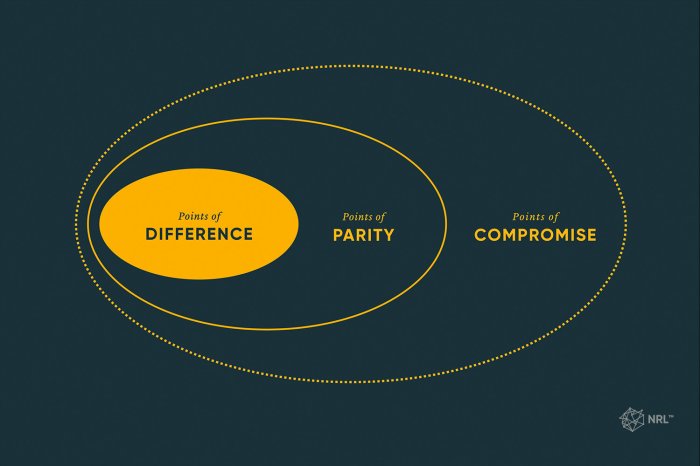
In the dynamic world of business, understanding the difference between competitive advantage and competitive parity is crucial for success. Competitive advantage, the coveted position of market dominance, allows a company to outperform rivals through unique strengths. Conversely, competitive parity, while not as glamorous, represents a necessary benchmark where companies strive for equal footing within their industry. This exploration delves into the strategies, challenges, and nuances of both, providing a framework for businesses to assess their position and chart a course towards sustainable growth.
This analysis will examine the various sources of competitive advantage, from innovation and cost leadership to superior customer service and brand loyalty. We will also dissect the methods companies utilize to achieve competitive parity, highlighting the importance of efficient operations and strategic market positioning. Through case studies and real-world examples, we aim to illuminate the path to achieving, maintaining, and even transitioning between these two critical business states.
Defining Competitive Advantage and Competitive Parity
Understanding the difference between competitive advantage and competitive parity is crucial for businesses aiming for sustainable growth and market leadership. While both relate to a company’s position relative to its competitors, they represent distinct levels of market performance and strategic positioning. This section will clarify these concepts and highlight their implications.
Competitive advantage and competitive parity are two key concepts in strategic management that describe a firm’s relative standing within its industry. A firm with a competitive advantage enjoys superior performance compared to its rivals, while a firm with competitive parity performs similarly to its competitors. The distinction is significant, impacting long-term profitability and market share.
Competitive Advantage Defined
A competitive advantage is a firm’s ability to create and sustain superior value compared to its competitors. This superior value can manifest in various forms, such as lower costs, higher quality, better customer service, or a unique product offering. The ultimate goal of achieving a competitive advantage is to gain market dominance, achieve higher profitability, and build a strong and sustainable business.
A company with a competitive advantage can command premium prices, attract and retain more customers, and ultimately generate higher returns than its competitors.
Competitive Parity Explained
Competitive parity, on the other hand, describes a situation where a firm performs at a similar level to its competitors. In this scenario, there’s no significant difference in terms of cost, quality, customer service, or other key performance indicators. While achieving competitive parity is essential for survival in a competitive market, it doesn’t guarantee long-term success or exceptional profitability.
Companies operating at competitive parity often struggle to differentiate themselves and may find themselves vulnerable to market changes and aggressive competitors. Their market share tends to remain relatively stable, but it may not grow significantly without further strategic adjustments.
Competitive Advantage vs. Competitive Parity
The following table compares and contrasts competitive advantage and competitive parity across several key features:
| Feature | Competitive Advantage | Competitive Parity | Example |
|---|---|---|---|
| Value Creation | Superior value for customers | Comparable value to competitors | Apple’s innovative design and user experience vs. other smartphone manufacturers offering similar basic functionalities. |
| Cost Structure | Lower costs than competitors or ability to justify premium pricing | Similar cost structure to competitors | Walmart’s efficient supply chain and low operating costs vs. other large retailers with comparable pricing strategies. |
| Market Share | Above-average market share, often dominant | Stable or slightly fluctuating market share | Google’s dominant position in search engines vs. other search engines with smaller, less impactful market share. |
| Profitability | Above-average profitability | Average or below-average profitability | Luxury car brands like Rolls-Royce commanding higher profit margins compared to mass-market car brands with lower profit margins. |
| Sustainability | Sustainable over time through innovation and adaptation | Vulnerable to competitive pressures and market shifts | Coca-Cola’s enduring brand recognition and global presence vs. numerous beverage companies facing fluctuating market share and challenges. |
Sources of Competitive Advantage
A company’s ability to outperform its rivals hinges on its competitive advantage. This advantage isn’t simply about being better; it’s about creating and sustaining a position that allows for superior profitability and market share. Several factors contribute to this crucial edge, ranging from innovative products to efficient operations.
Cost Leadership
Cost leadership involves becoming the lowest-cost producer in an industry while maintaining acceptable quality. This allows a company to offer lower prices than its competitors, attracting price-sensitive customers and gaining market share. Walmart, for example, has built its empire on this strategy, utilizing efficient supply chains and bulk purchasing to keep its prices consistently low. Their vast distribution network and sophisticated logistics further contribute to their cost advantage.
Differentiation
Differentiation focuses on creating a product or service that is perceived as unique and superior in the eyes of consumers. This uniqueness can stem from various aspects, such as superior quality, innovative features, strong branding, or exceptional customer service. Apple, with its emphasis on design, user experience, and brand image, is a prime example. Their products command premium prices because consumers perceive them as offering a superior user experience compared to competitors.
Focus Strategy
A focus strategy involves concentrating on a specific niche market segment rather than trying to appeal to the entire market. By specializing, a company can tailor its offerings to the unique needs and preferences of its target segment, building strong customer loyalty and commanding premium prices. A small, artisanal bakery focusing on organic, gluten-free products within a specific geographic area is an example of a company leveraging a focus strategy.
Their limited menu and specialized ingredients attract customers willing to pay more for quality and exclusivity.
Innovation
Innovation is the engine of competitive advantage, leading to the creation of new products, services, or processes that provide significant value to customers or improve efficiency. Tesla’s introduction of electric vehicles with advanced technology and superior performance exemplifies innovation-driven competitive advantage. Their continuous development of battery technology, autonomous driving features, and charging infrastructure has cemented their position as a leader in the electric vehicle market.
Strong Brand Equity
A strong brand enjoys high consumer recognition, trust, and loyalty. This allows a company to charge premium prices, command greater shelf space, and attract top talent. Coca-Cola, with its iconic brand and global recognition, exemplifies the power of brand equity. Their consistent marketing, product quality, and global presence have cultivated a brand image that transcends mere refreshment, becoming a cultural symbol and a source of sustained competitive advantage.
Sustainable Competitive Advantage Through Innovation: A Scenario
Imagine a pharmaceutical company, “BioGenesis,” developing a revolutionary new cancer treatment. This treatment, unlike existing therapies, offers significantly higher efficacy with fewer side effects. BioGenesis aggressively patents its technology and invests heavily in clinical trials, securing regulatory approvals. They also build a strong intellectual property portfolio surrounding the drug’s production process and delivery mechanisms. The combination of superior efficacy, reduced side effects, strong patent protection, and process innovation creates a significant and sustainable competitive advantage, allowing BioGenesis to command premium pricing and maintain market dominance for an extended period.
Challenges in Maintaining Competitive Advantage in a Rapidly Evolving Market
Maintaining a competitive advantage in dynamic markets is a constant struggle. Rapid technological advancements, shifting consumer preferences, and the emergence of disruptive competitors create significant challenges. Companies must constantly innovate, adapt their strategies, and invest in research and development to stay ahead of the curve. For example, the rise of e-commerce significantly impacted traditional brick-and-mortar retailers, forcing them to adapt their business models and embrace digital strategies to survive.
Failing to adapt to these changes quickly can lead to a loss of competitive advantage and even market failure.
Achieving Competitive Parity
Achieving competitive parity, while not as glamorous as securing a competitive advantage, is a crucial goal for many businesses. It represents the ability to match the performance of industry rivals, ensuring survival and providing a stable foundation for future growth. This often involves strategically aligning operations and resources to meet, but not necessarily surpass, the industry standard. A company achieving parity avoids being significantly disadvantaged but also doesn’t necessarily enjoy outsized market share or profitability.
Strategies for achieving competitive parity are multifaceted and depend heavily on the specific industry and competitive landscape. Successful parity often requires a deep understanding of competitor actions and market dynamics.
Strategies for Achieving Competitive Parity
Several strategic approaches can help a company reach competitive parity. These approaches aren’t mutually exclusive; many firms employ a combination of tactics.
- Benchmarking and Best Practices Adoption: Systematically analyzing the processes and performance of leading competitors to identify areas for improvement and implement best practices. This involves studying successful strategies, operational efficiencies, and customer service models of top players in the industry. For example, a smaller regional bank might benchmark its customer service processes against a larger, nationally recognized bank, adopting elements like streamlined online banking platforms or improved customer communication protocols.
- Operational Efficiency Improvements: Focusing on streamlining internal processes, reducing waste, and improving productivity. This can involve implementing lean manufacturing techniques, optimizing supply chains, or investing in automation. A clothing manufacturer, for example, might achieve parity by improving its supply chain management, reducing lead times and inventory costs to match its more established competitors.
- Strategic Partnerships and Alliances: Collaborating with other companies to access resources, technologies, or markets that would otherwise be difficult or costly to obtain independently. This could involve joint ventures, licensing agreements, or distribution partnerships. A smaller pharmaceutical company might partner with a larger one to gain access to a wider distribution network and achieve parity in market reach.
- Investing in Technology and Innovation: While not necessarily leading to a competitive
-advantage*, investing in technology and innovation can help a company keep pace with competitors. This ensures the company doesn’t fall behind in terms of technological capabilities or product offerings. A smaller software company might invest in cloud computing infrastructure to achieve parity with larger competitors in terms of scalability and reliability. - Strong Brand Building and Marketing: Cultivating a positive brand image and effectively communicating the company’s value proposition to target customers. Even without a unique product, a strong brand can attract customers and achieve competitive parity through brand loyalty and recognition. A new entrant in the coffee market might achieve parity by focusing on a strong brand identity and targeted marketing campaigns to build awareness and customer base.
Cost Leadership and Competitive Parity
Cost leadership, while often associated with achieving a competitive
-advantage*, can also be a key component of achieving competitive parity. By reducing costs across the value chain, a company can offer competitive pricing without sacrificing profitability. This allows them to match the prices of competitors while maintaining healthy margins.
Achieving cost leadership involves identifying and eliminating unnecessary expenses, optimizing production processes, and negotiating favorable terms with suppliers. For example, a furniture manufacturer might achieve cost parity by negotiating bulk discounts from suppliers, streamlining its manufacturing processes, and reducing waste.
Comparing Approaches to Achieving Competitive Parity
The effectiveness of different approaches to achieving competitive parity varies depending on the market conditions. In highly competitive, price-sensitive markets, cost leadership strategies are crucial. In markets where differentiation is key, focusing on brand building and product innovation might be more effective. In rapidly changing markets, agility and adaptability through strategic partnerships or technological investments become paramount.
For instance, in a mature market with established players, benchmarking and operational efficiency improvements might be sufficient to achieve parity. However, in a dynamic, emerging market, a focus on innovation and strategic partnerships may be necessary to keep up with the pace of change and avoid falling behind.
Competitive Advantage vs. Competitive Parity
Understanding the difference between competitive advantage and competitive parity is crucial for business success. Competitive advantage allows a firm to outperform its rivals, while competitive parity implies that firms are essentially equal in their market performance. This section explores these concepts through real-world examples and comparative analyses.
A Hypothetical Case Study: From Parity to Advantage
Imagine “Coffee Corner,” a small coffee shop initially operating at competitive parity with other local cafes. They offered similar products, pricing, and services. Their market share was stable but unremarkable. To achieve competitive advantage, Coffee Corner implemented several strategic changes. They invested in ethically sourced, high-quality beans, developed unique coffee blends, and created a welcoming atmosphere with comfortable seating and free Wi-Fi.
They also implemented a loyalty program and began offering workshops on coffee brewing techniques. This multi-pronged approach differentiated them from competitors, attracting a loyal customer base and increasing their market share significantly. The shift from relying on basic offerings to providing a superior customer experience and unique product offerings propelled Coffee Corner from competitive parity to a clear competitive advantage.
Comparative Analysis: Two Company Strategies
The following table compares two companies, one with a strong competitive advantage and one operating at competitive parity within the same industry (e.g., the fast-food industry):
| Company | Strategy | Market Position | Outcome |
|---|---|---|---|
| Burger Supreme (Competitive Advantage) | Focus on high-quality ingredients, innovative menu items, superior customer service, and strong branding. Significant investment in R&D and marketing. | Dominant market share, premium pricing, high customer loyalty. | High profitability, strong brand recognition, consistent growth. |
| Burger Bistro (Competitive Parity) | Offers a standard menu, average pricing, and basic service. Minimal marketing and investment in innovation. | Small market share, price-sensitive customers, low customer loyalty. | Low profitability, vulnerable to competition, stagnant growth. |
Leveraging Competitive Advantage to Overcome Challenges
A company with a strong competitive advantage can effectively mitigate threats from competitors operating at competitive parity. For example, Burger Supreme, with its superior brand reputation and loyal customer base, could withstand price wars initiated by Burger Bistro. Its focus on quality and innovation allows it to command premium prices, making it less susceptible to price competition. Furthermore, Burger Supreme’s strong brand image and customer loyalty provide a buffer against competitor encroachment.
Even if Burger Bistro offers slightly lower prices, Burger Supreme’s customers are less likely to switch due to their preference for quality and the overall experience. In essence, a well-established competitive advantage provides resilience against the challenges posed by competitors operating at a basic level.
The Role of Innovation in Competitive Advantage
Innovation plays a pivotal role in establishing and maintaining a competitive advantage. Companies that consistently develop and implement new ideas, products, or processes often outperform their rivals by creating value for customers that competitors cannot easily replicate. This value creation can manifest in various forms, from superior product features and enhanced user experiences to more efficient operations and lower costs.
Ultimately, successful innovation translates into increased market share, higher profitability, and stronger brand loyalty.Innovation’s contribution to competitive advantage stems from its ability to disrupt existing market dynamics. By introducing novel solutions to existing problems or creating entirely new markets, innovative companies can leapfrog competitors and establish a commanding position. This often involves significant upfront investment in research and development, but the potential returns can be substantial.
Furthermore, continuous innovation is crucial for sustaining a competitive edge in dynamic markets, as competitors constantly strive to catch up. A company that rests on its laurels risks losing its advantage to more agile and innovative rivals.
Disruptive Innovation and Competitive Advantage
Disruptive innovation, characterized by introducing simpler, more affordable, and often initially less sophisticated products or services, can lead to significant competitive advantages. These innovations often target underserved or neglected market segments, eventually expanding to disrupt the mainstream market. A classic example is the rise of digital photography. Initially, digital cameras offered lower image quality than film cameras, but their convenience, ease of use, and cost-effectiveness gradually attracted a wider audience.
As technology advanced, digital cameras surpassed film cameras in quality, ultimately rendering the latter obsolete. This demonstrates how a seemingly inferior initial offering, through continuous innovation, can achieve market dominance and displace established players. Another example is the impact of smartphones on the traditional mobile phone market. Smartphones, initially more expensive and complex than basic mobile phones, eventually superseded them due to their superior functionality and app ecosystem.
Risks Associated with Innovation Investment
Investing heavily in innovation to gain a competitive advantage carries inherent risks. The primary risk is the uncertainty of success. Research and development efforts are often expensive and time-consuming, with no guarantee of yielding commercially viable outcomes. Many innovative products and services fail to gain traction in the market, leading to significant financial losses. Furthermore, even successful innovations may not translate into a sustainable competitive advantage if competitors quickly replicate them or develop superior alternatives.
This necessitates a robust intellectual property strategy to protect innovations and maintain a competitive edge. Another risk is the potential for disruptive innovations to render existing products or services obsolete, creating significant challenges for companies heavily invested in those older technologies. The rapid pace of technological change necessitates continuous adaptation and a willingness to embrace new technologies, even if it means cannibalizing existing business models.
Analyzing Competitive Landscape
Understanding a company’s competitive landscape is crucial for sustained success. A thorough analysis reveals not only where a company excels but also where it needs improvement, informing strategic decisions and resource allocation. This involves identifying areas of competitive advantage – aspects that set the company apart from rivals – and areas of competitive parity – where it matches or lags behind competitors.A robust framework for analyzing the competitive landscape incorporates both internal and external factors.
This involves examining the company’s internal strengths and weaknesses, and juxtaposing these against the opportunities and threats presented by the external environment. This allows for a holistic view of the competitive position.
SWOT Analysis for Competitive Advantage and Parity Assessment
The SWOT analysis provides a structured approach to assessing competitive advantage and parity. It systematically categorizes internal factors (Strengths and Weaknesses) and external factors (Opportunities and Threats). Strengths represent internal capabilities that provide a competitive edge, while Weaknesses highlight areas where the company lags behind competitors. Opportunities are external factors that could be exploited to gain a competitive advantage, and Threats are external factors that could hinder performance or erode existing advantages.
By mapping these elements, a clear picture emerges of the company’s competitive standing. For example, a company with strong brand recognition (Strength) in a growing market (Opportunity) might have a significant competitive advantage. However, if it lacks efficient production processes (Weakness) and faces increasing competition from innovative rivals (Threat), its advantage might be diminished. The interplay between these factors determines the overall competitive position.
Monitoring the Competitive Landscape
Regular monitoring of the competitive landscape is essential for maintaining a competitive edge or parity. The business environment is dynamic; competitors constantly innovate, market conditions shift, and customer preferences evolve. Without continuous monitoring, companies risk losing their competitive advantage or failing to adapt to emerging threats. This involves tracking competitors’ actions (new product launches, pricing strategies, marketing campaigns), analyzing market trends (changes in consumer demand, technological advancements, regulatory changes), and identifying emerging opportunities.
Companies may use various tools for this purpose, such as market research reports, competitor analysis databases, and social media monitoring. Proactive adaptation based on this monitoring allows companies to adjust their strategies, refine their offerings, and maintain a relevant and competitive position in the market. For instance, a company observing a competitor’s successful new product launch might accelerate its own product development or adjust its marketing strategy to counter the threat.
Conversely, a company identifying an underserved niche could leverage this opportunity to expand its market share.
Sustaining Competitive Advantage
Maintaining a leading position in the market requires more than just achieving a competitive advantage; it demands a proactive and adaptable strategy to sustain that advantage over the long term. This involves not only understanding the sources of competitive advantage but also anticipating and mitigating threats that could erode it. Companies that successfully sustain their leadership often demonstrate a commitment to continuous innovation, robust intellectual property protection, and a keen awareness of the ever-shifting competitive landscape.Sustaining a competitive advantage necessitates a multi-faceted approach.
Strategies include continuous innovation to create new products and services, proactive adaptation to changing market conditions, building strong customer relationships to foster loyalty, and fostering a culture of efficiency and operational excellence. These elements work in synergy to create a resilient business model that can withstand competitive pressures.
Strategies for Sustaining Competitive Advantage
Several key strategies are crucial for long-term market leadership. These include investing heavily in research and development to stay ahead of the curve, building a strong brand reputation that resonates with consumers, and cultivating a highly skilled and motivated workforce. Furthermore, strategic partnerships and alliances can expand market reach and access valuable resources. Finally, a flexible and agile organizational structure allows companies to respond quickly to market changes and seize emerging opportunities.
Factors that Erode Competitive Advantage and Mitigation Strategies
Several factors can undermine a company’s competitive advantage. These include the emergence of new competitors with disruptive technologies, changes in consumer preferences, shifts in regulatory environments, and economic downturns. To mitigate these risks, companies should implement robust market monitoring systems to identify emerging threats early on. Diversification of product offerings and markets can reduce reliance on a single source of revenue.
Furthermore, building strong relationships with suppliers and distributors ensures a reliable supply chain and reduces vulnerability to disruptions. Investing in employee training and development keeps the workforce adaptable and capable of handling new challenges.
Protecting Intellectual Property to Maintain Competitive Advantage
Protecting intellectual property (IP) is paramount for sustaining a competitive advantage. A comprehensive IP protection plan should include several key elements. First, a thorough IP audit should be conducted to identify all valuable IP assets, including patents, trademarks, copyrights, and trade secrets. Second, a robust patent strategy should be implemented to protect inventions and innovations. This involves filing patent applications in key jurisdictions and actively monitoring for potential infringements.
Third, trademark registration protects brand identity and prevents unauthorized use. Fourth, copyright protection safeguards original works, such as software code, designs, and marketing materials. Finally, implementing strong confidentiality measures, such as non-disclosure agreements (NDAs) and secure data management practices, protects trade secrets. Regular reviews and updates of the IP protection plan are crucial to adapt to evolving legal frameworks and competitive dynamics.
For example, a pharmaceutical company might protect its novel drug formula through patents, while a software company might protect its unique algorithms through copyright and trade secret protection. This layered approach maximizes the chances of maintaining a competitive edge through robust IP security.
Ultimately, the journey from competitive parity to competitive advantage, or the strategic maintenance of either, requires a keen understanding of the market landscape, a commitment to innovation, and a proactive approach to risk management. By consistently analyzing the competitive landscape, adapting strategies, and leveraging available resources effectively, businesses can navigate the complexities of market dynamics and achieve sustainable success.
Whether striving for market dominance or secure industry standing, a thorough understanding of competitive advantage and competitive parity forms the bedrock of sound business strategy.
Commonly Asked Questions
What is a sustainable competitive advantage?
A sustainable competitive advantage is one that is difficult for competitors to imitate or overcome in the long term, often stemming from unique resources or capabilities.
Can a company have both competitive advantage and competitive parity in different market segments?
Yes, a company might hold a competitive advantage in one market segment while operating at competitive parity in another, depending on its resources and strategic focus.
How important is brand reputation in achieving competitive advantage?
Brand reputation plays a significant role, contributing to customer loyalty and potentially justifying premium pricing, thus enhancing competitive advantage.
What are some examples of disruptive innovations that created competitive advantages?
Examples include the introduction of the iPhone, the rise of Netflix, and the emergence of ride-sharing services like Uber.